

PHOTOGRAPHY & TRAVEL · ICEMONKEY JOURNAL
Morocco Photography Tour: Best Places, Best Time and What to Pack

Few photography tours give you blue alleys, a medieval medina, cedar forests with wild monkeys, Saharan dunes and a truly dark sky in one trip. Morocco does. This is where we take our groups, when we go, and what we have learned about getting the pictures.
The best places to photograph in Morocco
This is not a complete list. These are the places we return to with our groups because they reliably deliver strong images, in a route that makes sense without endless driving.
Chefchaouen, the Blue City
Walls, stairs and doorways painted in every shade of blue, in a small medina in the Rif Mountains. The trick is to arrive early, before the streets fill up, and to work with the soft, bounced light that the blue walls produce. A 24-70 mm lens covers almost everything here; keep your eye on the details of doors, pots and shadows rather than only the wide street views everyone photographs.
Volubilis and Fez
The Roman ruins of Volubilis, on open farmland on the way to Fez, give clean compositions of columns against a big sky in late-afternoon light. Fez itself is the hardest place on the route to photograph and the most rewarding: the medina is dark, narrow and busy, so a fast standard zoom and a higher ISO than you would like are the normal tools. The tanneries are photographed from the terraces above, rows of dye pits in ochre, white and red. Ask before photographing people, and expect some to say no.
The cedar forest of the Middle Atlas
Between Fez and the desert the road climbs through cedar forest where Barbary macaques live wild. This is the one stop on the trip where a telephoto (70-200 mm, or longer if you carry it) earns its place in the bag.
Merzouga and the Sahara dunes
The dunes of Merzouga are the heart of any Morocco photography tour. Sunrise and sunset give you ridge lines, shadow and texture; the hours in between are harsh, so we use them for rest and editing. Camels on a ridge against the low sun are the classic silhouette: get below the ridge line so the animals stand against sky, not sand. At night, with no towns nearby, the sky is dark enough for serious Milky Way work.

Todra Gorge and the Valley of Roses
West of the desert, the Todra Gorge gives you vertical rock walls and a narrow strip of sky, and the Valley of Roses sets green oasis farmland against bare mountains. Both are quick, high-contrast stops.
Ouarzazate and Ait Ben Haddou
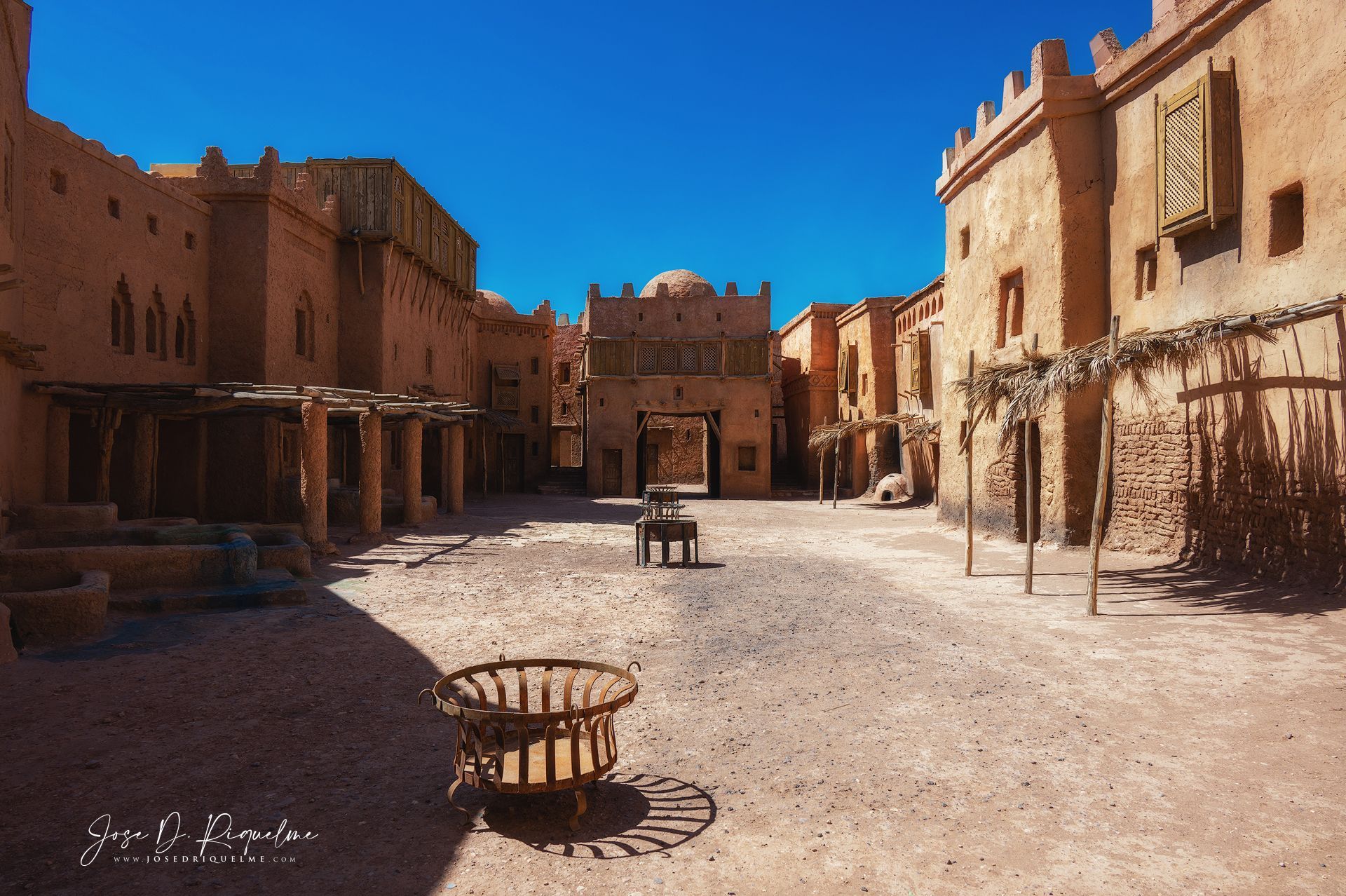
The film studios of Ouarzazate are full of built sets with clean geometry and hard shadows, good practice for architectural compositions. Nearby, the kasbah of Ait Ben Haddou, a UNESCO World Heritage site, is best in the first hour of light, when the mud walls glow and the crowds have not arrived.
Marrakech
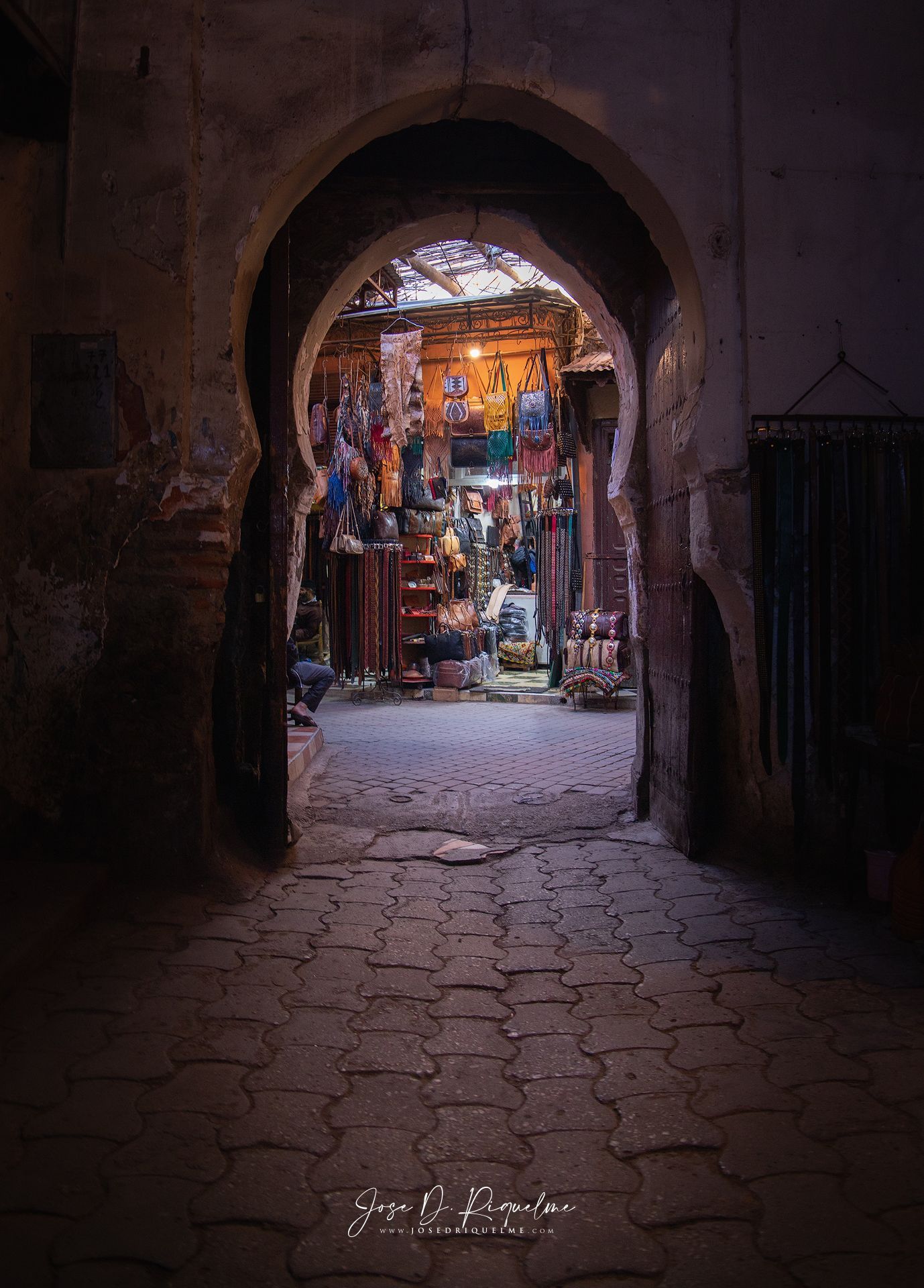
The souks, the hidden gardens and Jemaa el-Fnaa square at dusk. Marrakech is about people, colour and movement: put the tripod away, raise the ISO and shoot handheld. The blue hour over the square, from a terrace, is the classic closing image of the trip.
When to go: light, heat and the Milky Way
We run our Morocco photography workshop in April, and we chose those dates for a reason. Days are warm but not punishing, nights in the mountains and the desert are cool, and the dates line up with good nights for the Milky Way, so the night sessions in the Sahara are the centre of the trip, not an afterthought. Light rain is possible in the north in April, so a light waterproof jacket goes in the bag.
High summer in the interior and the Sahara is very hot, which limits how long you can work outdoors in the middle of the day. There is one special reason to go in summer anyway: a total solar eclipse crosses Morocco on 2 August 2027, and we have a separate Morocco total solar eclipse photo tour built around it, with the eclipse observed from Tangier.
What to pack for a Morocco photography tour
Our gear list for Morocco is short on purpose: dust and sand are the main enemies, and you will walk a lot in medinas where a heavy bag becomes a burden.
- Camera with full manual control, DSLR or mirrorless.
- A fast wide-angle (14-24 mm or similar) for landscapes, architecture and, above all, the Milky Way.
- A standard zoom (24-70 mm) for streets, portraits and everyday scenes. If you only bring one lens, bring this one.
- A telephoto (70-200 mm; 100-400 or 200-600 mm optional) for the macaques and distant details.
- A sturdy tripod with a ball head, a remote release or intervalometer, and a headlamp with a red-light mode for the night sessions.
- Filters: a polariser, and a 6-stop ND if you like long exposures.
- Protection: a rain cover, dust and sand protection for the bag, a lens-cleaning kit and an air blower.
- Spare batteries, chargers and memory cards, plus a laptop with Photoshop and Camera Raw for the editing sessions.
Clothing: dress in layers. Comfortable closed shoes for medinas and sand, breathable long sleeves against sun and dust, a fleece or light insulated jacket for mornings and desert nights, lightweight trousers, a hat, sunglasses and a scarf that doubles as dust protection. Modest clothing is appreciated in villages and at cultural sites.
Drones: leave it at home unless you have been told in writing that a permit is in place. Morocco requires official authorisation to import and fly a drone, and customs can retain unauthorised units on arrival.
How to photograph the Milky Way in the Sahara
The desert nights are why most photographers choose Morocco, so prepare for them before you fly.
- Plan the night. Check the moon phase and when the galactic core rises for your dates; in spring the core is best in the second half of the night, so expect late sessions.
- Focus before dark. Set manual focus on a distant light or a bright star using live view at maximum magnification, then do not touch the ring.
- Start from a base exposure. With a 14 mm lens at f/2.8, 15 to 20 seconds at ISO 3200 to 6400 is a sensible starting point. Judge the histogram, not the preview.
- Use the dunes as foreground. A clean ridge line, a single figure or a line of footprints gives the sky scale. Walk out of frame along the back of the dune so your tracks do not cross the shot.
- Shoot panoramas for the arch. In spring the Milky Way forms a low arch; a row of vertical frames stitched later holds far more detail than a single wide shot. Our free guides cover the full workflow.
Mistakes we see on every trip
Photographing people without asking, in a country where many will say yes if you do. Changing lenses in the wind on the dunes. Arriving at Ait Ben Haddou or Chefchaouen at midday instead of first light. Trusting the camera screen at night and coming home with underexposed, noisy files. Packing three heavy lenses and leaving them in the hotel because the medina is a long walk. All avoidable, and on our trips a guide is next to you to catch them before they cost you the shot.
On our Morocco photo tour
Our Morocco Photography Workshop runs from 1 to 11 April 2027: 11 days and 10 nights, with a maximum of 10 travellers, led by José D. Riquelme with a local Moroccan team. The route runs from north to south through the places in this article: Chefchaouen, Volubilis, Fez, the cedar forest of the Middle Atlas, Merzouga and the Sahara, Todra Gorge, the Valley of Roses, Ouarzazate, Ait Ben Haddou and Marrakech. The workshop is open to all levels, and non-photographer companions are welcome.
Frequently asked questions
Do I need to be an experienced photographer?
No. Our Morocco workshop is open to all levels, from beginners to experienced photographers. Partners who do not photograph are welcome too.
Which lens matters most for Morocco?
A 24-70 mm covers most of the trip. Add a fast wide-angle if the Milky Way sessions are a priority for you, and a telephoto if you want the Barbary macaques.
Can I bring a drone?
Not unless official Moroccan authorisation has been confirmed in writing beforehand. Without it, the drone may be retained at customs, so we do not include aerial photography on this trip.
Ready to plan your Morocco photography tour?
See the dates, the full itinerary and the gear list on the Morocco Photography Workshop page, or the August 2027 eclipse tour if you want the Sahara and a total solar eclipse in one trip. And before you go, download our free photography guides, including the Milky Way guide that covers planning, focusing, panoramas and processing step by step.
FROM INSPIRATION TO EXPERIENCE
Your next photography journey starts here.
Explore extraordinary places with the IceMonkey team.
Explore all our tours →